Self-Censorship
ChucK/ChuGL, Feburary 2026Write anything in this terminal; write as much as you want. But be aware the words might disappear. And the best part is, you don’t know which word would get removed, for what reason, and if it will ever come back.
Video Demonstration
The recorded demonstration documents the author performing within this system, composing a poem directly on the subject while witnessing words being erased in real time. It is worth noting that it was the text that’s accompanying the piano, not the other way around. For the demonstration, she composed and recorded a piano background music in advance.
What is it?
Self-Censorship is a live musical and textual environment based on ChAI (AI in ChucK) where typing becomes performance and erasure becomes sound. Within the work, users are granted maximum freedom to type anything into a terminal interface, while confronting the persistent risk that the input words may be algorithmically erased.
A set of words have been predefined as “censored”, but also an algorithm would search for similar words by K-nearest, therefore the author herself also does not complete knowledge over what might be erased. When a word is identified as “censored,” the system triggers automated backspacing to remove it immediately from the visible sentence. At the moment of erasure, a layered sonic response is produced, composed of two simultaneous elements. The first is the word’s true pronunciation, generated via built-in text-to-speech. The second layer is a distorted, mosaiced reconstruction of that pronunciation, created through audio vector-space similarity search and concatenative synthesis. Audio fragments within this reconstruction are selected according to spectral and energetic resemblance to the original pronunciation.
Self-Censorship is not designed just as an interface; it is also a reflective instrument that forces witnesses. By rendering erasure audible and performative, it invites audiences to confront the tension between the agency we possess and the constraints we encounter.
Inspiration
The author created this piece when reflecting upon the doctrinality of societies. It is an emotional reaction to the restraints upon us, implicitly or explicitly, by customs and rules. In this piece, she invited the machine to co-create with her, through playing a vicious character, to replicate a partial truth of the system we live in.
Flower.Mirror
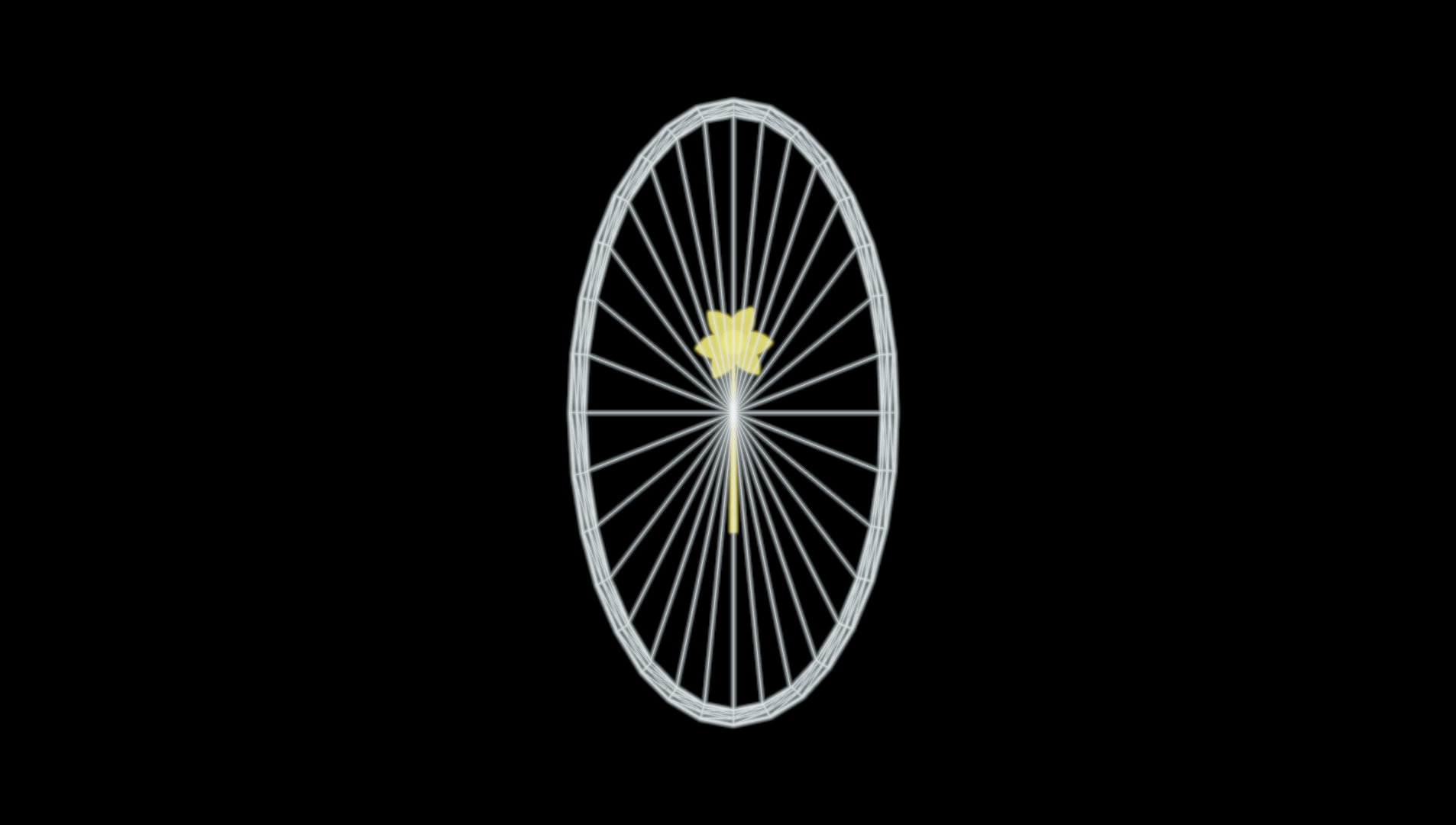
ChucK/ChuGL, December 2025Flower.Mirror is a pair of poetry-driven musical games. What will appear when you turn the mirror around?

Video Demonstration
What is it?
Flower.Mirror is a poetry-driven multimedia interactive game that explores the interplay of poetry, sound, and visual space. The program guides its player through dream-like landscapes, where the player puzzles through and trigger stages of the game by constructing texts into poetic phrases. Instead of a goal-oriented structure, the experience unfolds in a meditative and contemplative state, allowing each gesture, sound, and transition to take its time. The player is invited into a slower mode of exploration, one that emphasizes listening, patience, and reflection, and gradually enters the intercultural narrative embedded within the project.

“Mirror” and “Flower”
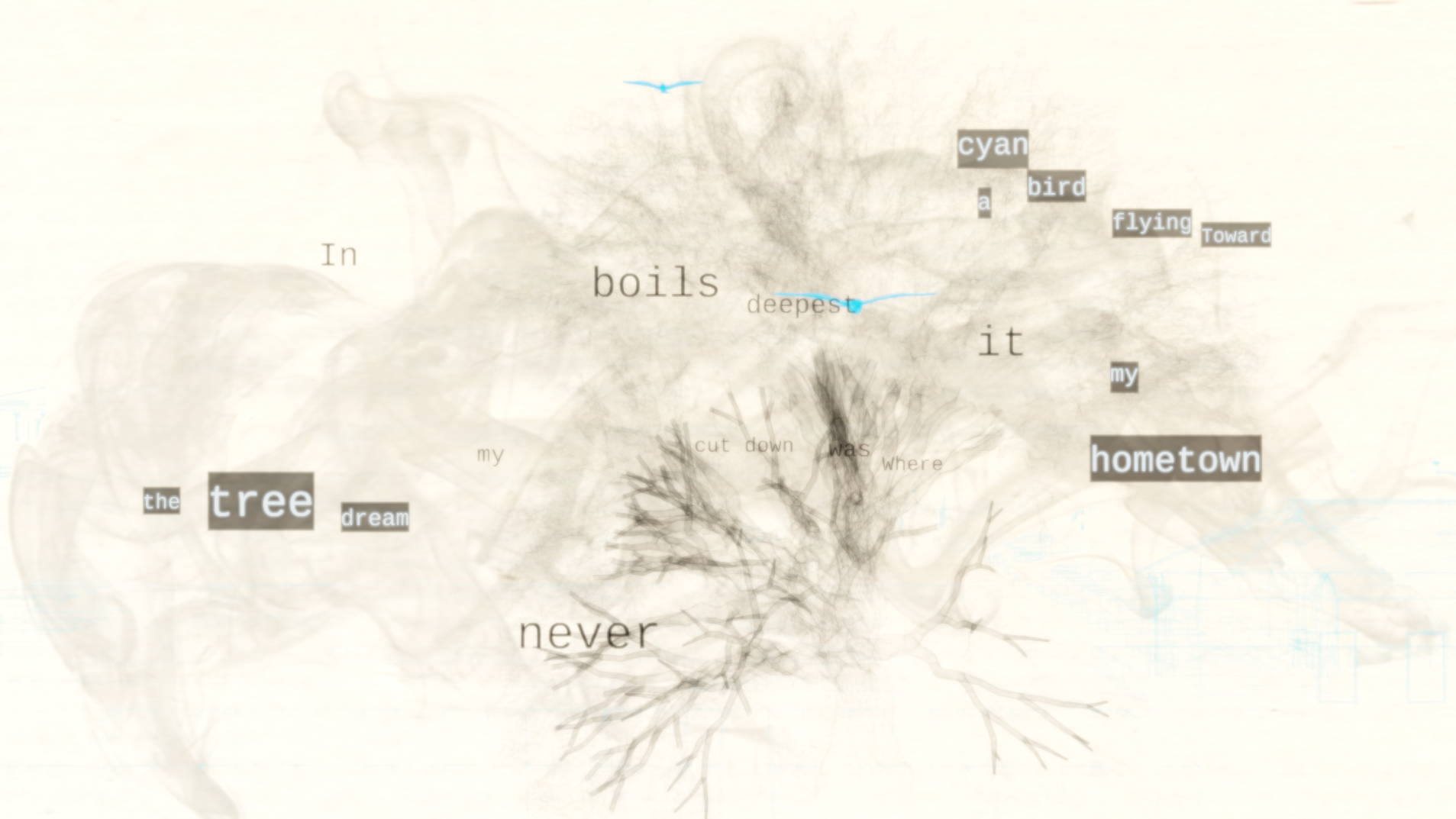
As its title suggests,Flower.Mirror unfolds across two chapters: “Mirror” and “Flower,” where each is a multi-staged miniature poetic game. “Mirror” reflects a period in the artist’s life marked by anemoia—the reconstruction of memory around an idealized hometown that never truly existed, formed during her first experience studying abroad. The player engages with language as a compositional material, modulating nouns with verbs and adjectives by aligning words horizontally, as if writing a poem in the space. Decisions regarding text placement directly shape the sound: the size of a selected text determines its associated sound’s volume, while the drop location of the text affects its stereo panning.
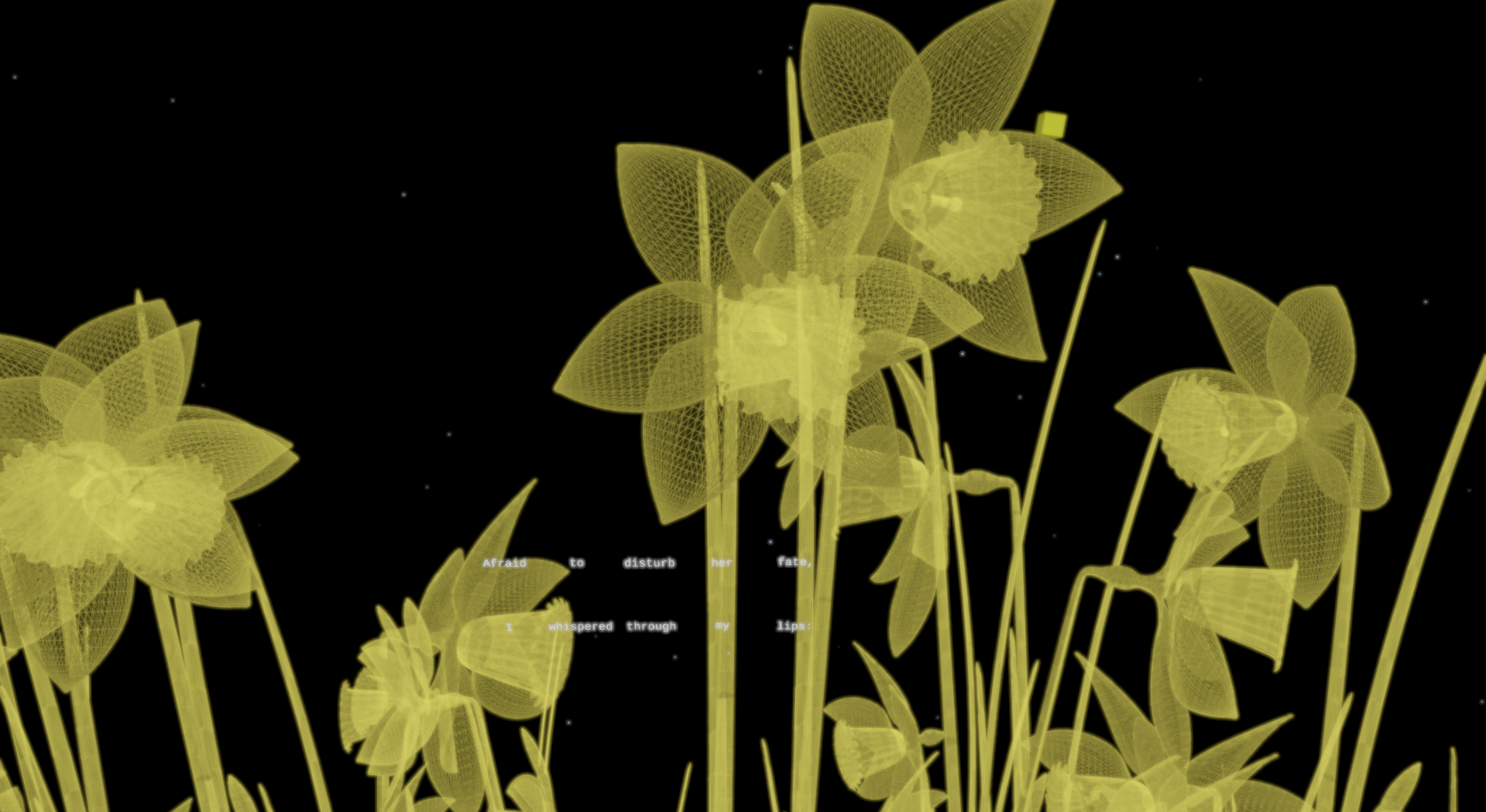
“Flower” represents a stage of reconciliation. In this chapter, the artist quietly looks back on her childhood self, recognizing the beauty of uncertainty and unknowing, and learning to embrace her past and present selves. These personal narratives are presented not as fixed stories, but as fragments—moments that surface, dissolve, and reappear through interaction. Across multiple stages, players align words to initiate musical development before transitioning into a navigational mode, where hidden words are discovered and collected within a darkened visual field. The interaction becomes increasingly embodied, shifting from writing to movement and presence.

Inspiration
The ideas of “Flower” and “Mirror” are deeply intertwined in traditional Chinese culture. The project draws inspiration from Dream of the Red Chamber, where the concept of 镜花水月 (“Mirror, Flower, Water, Moon”) is a recurring theme. Often translated as “flower in the mirror, moon on the water,” the phrase describes a beauty that is vivid yet transient. Through this lens, the project observes the worldly concerns tied to intercultural identity, how they evolve over time, rise and fall in cycles of yin and yang, and eventually soften into reconciliation. Our life, like the flower in the mirror, is filled at times with loneliness and sorrow, at others with joy and tenderness, yet remains a fleeting experience.The-Three-Fates
ChucK/ChuGL Code, October 2025
“The-Three-Fates” is a Chuck Audio-Visual Interactive program I wrote. Functionally it reflects time-based and spectral-based waveforms, as well as the history. Aesthetically it narrates the notion of life, death, and time.
Video Demonstration
Core Mechanism
Press ’S’ to rotate the spindle, which spins off one thread at a time. The number of threads that can be spun off is not limited.Press ‘H’ to move the hand, which combs the thread(s) and randomly makes them pass by quicker or slower.
Press ‘C’ to operate the scissors, which cut all threads at one time.
Through mouse control, you can rotate the screen, zoom in, and or zoom out.
Background
In Greek mythology, three sister goddesses together determine the fate of mortals. Clotho, the Spinner, spins the thread of life; Lachesis, the Allotter, measures its length and trials; and Atropos, the Inflexible, cuts it with her shears to end a life. Together they are known as the Three Fates, or Moirai.I was immediately drawn to this myth when learning about the project’s requirements, as I’ve long been fascinated by the notion of time. Music is inherently time-based, as is ChucK, whose programming flow mirrors the passage of moments. A waveform moving across the screen can be seen as a thread of sound—and by extension, of life—experienced linearly through time.
This concept shaped my visual design. Inspired partly by NieR:Automata, a sci-fi game that contemplates humanity through a futuristic lens, I aimed for an aesthetic that feels cold, mechanical, and pure—reflecting the divine detachment and ruthlessness of the Fates. Yet, I also wanted organic traces: eyes—perhaps three instead of two—hovering in a star-dusted void, suggesting both human vulnerability and divine distortion.
Spatialization of “Dream of Spring”
Reaper/Ambisonics, October 2025
To fully utilize the Multichannel setup of CCRMA Transitional Concert 2025, Li Ji and I created a 16-channel version of my 2024 composition “Dream of Spring”, which was originally composed for a VR film.
Concert Recording
W411
MaxMsp Patch, Dec 2022Th W4ll is a MaxMsp endeavor that MC (yes, another MC) and I collaborated on. I approached MC to embark on this venture after conceiving the idea of creating an interactive object that metaphorically represents post-pandemic communication between individuals, I approached MC to collaborate on this venture.
With a focus on sound design, I delved into designing the auditory aspects, while MC took charge of the visual reactions. The name "W411" abstracts the physical installation, signifying that it embodies more than a singular concept. We intentionally chose this name to encourage audience interpretation. In the accompanying video, you will witness unique visual and auditory responses triggered by my method of interaction with the wall, each time delivering a distinct outcome.
@MorningClose